


Why is KRZ a step in the right direction?
Although the National Debt Register (KRZ) has been criticized for its technical issues, complex interface, and lack of integration with other systems, it is worth emphasizing that its creation was not only necessary but inevitable. KRZ has introduced a new level of transparency to economic life in Poland. It is a tool that can and should be developed, but it already offers tangible benefits for entrepreneurs, creditors and individuals.
Contents:
- What is the National Register of Indebted Persons?
- Disclosure of entities in the National Register of Indebted Persons.
- How to access data entered in the National Debt Register?
- Functioning of the National Register of Indebted Persons
- Is it possible to delete data from the National Debt Register?
- Summary
- Directions of KRZ development:
What is the National Register of Indebted Persons?
The National Debt Register (KRZ) is an information system that provides access to public data on individuals and legal entities involved in bankruptcy or restructuring proceedings in Poland. It is a public register maintained by the Minister of Justice using an electronic system. The KRZ portal aims to increase transparency in the circulation of information regarding debtors, which is intended to lead to, among other things, improved functioning of the credit market and protection of creditors' interests. Importantly, the register is free of charge, and each interested parties can read the data contained in KRZ. The KRZ portal contains information about:
- natural persons who are subject to bankruptcy proceedings (e.g. consumer bankruptcy),
- legal entities (companies, enterprises) that are subject to bankruptcy or restructuring proceedings,
- persons against whom bankruptcy proceedings are pending,
- persons who have been discharged of debt or in other cases have completed bankruptcy proceedings.
The system allows for the effective management of data relating to bankruptcy proceedings, which facilitates the work of courts and other bodies involved in debt relief processes.
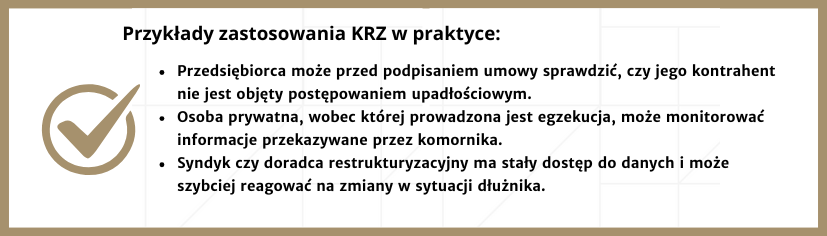
The KRZ portal is part of a broader debt monitoring system that aims to improve the efficiency of bankruptcy proceedings in Poland and facilitate debt recovery. The National Debt Register is an important tool in the legal system, supporting effective debt management and bankruptcy processes in Poland. It is used in types of proceedings such as:
- Consumer bankruptcy: Applies to natural persons who do not conduct business activity and the proceedings are aimed at debt relief.
- Bankruptcy proceedings for enterprises (economic bankruptcy of an entrepreneur): Concerning companies that cannot pay their debts.
- Restructuring proceedings: Anticipating actions aimed at restructuring debt, enabling the company to continue its operations.
Disclosure of entities in the National Register of Indebted Persons.
The data disclosed in the register is intended to ensure readability and transparency of the proceedings. The method of data entry is also intended to ensure the security of its processing and ease of use of the register.
In the National Debt Register you can search for various types of entities, including:
- Individuals: both business owners and private individuals.
- Legal entities: such as companies, foundations and other organizations with legal personality.
- Organizational units that do not have legal personality: entities to which the law grants legal capacity.
Investigations are or have been conducted against entities disclosed in the register. restructuring proceedings, bankruptcy or secondary bankruptcy proceedings, proceedings concluded with a final judgment prohibiting the conduct of business activity, as well as regarding the recognition of a judgment on the initiation of foreign bankruptcy proceedings.
The register also discloses information on partners in commercial partnerships who are liable for the company's obligations without limitation with all their assets, if the company's bankruptcy has been declared, secondary bankruptcy proceedings have been initiated against the company or a bankruptcy petition has been dismissed, if the assets of the insolvent debtor are not sufficient to cover the costs of the proceedings or are sufficient only to cover these costs, and also if the debtor's assets are encumbered with a mortgage, pledge, registered pledge, tax lien or maritime mortgage to such an extent that the remaining assets are not sufficient to cover the costs of the proceedings. The register also contains information on natural persons, legal persons and organisational units without legal personality to which the law grants legal capacity - against whom enforcement proceedings conducted by a court bailiff or court have been discontinued due to the fact that no amount higher than the enforcement costs will be obtained from the enforcement, or enforcement proceedings conducted by the head of the tax office or the director of a branch of the Social Insurance Institution have been discontinued due to the fact that no amount higher than the enforcement costs will be obtained from the enforcement proceedings, as well as information on natural persons against whom enforcement of maintenance payments or enforcement of state budget receivables arising from benefits paid in the event of ineffective enforcement of maintenance payments is pending and who are in arrears with the payment of these benefits for a period longer than 3 months.
Importantly, the National Register of Indebted Persons does not disclose information on cases in which the application was submitted before the date of entry into force of the Act on the National Register of Indebted Persons, i.e. before December 1, 2021.
How to access data entered in the National Debt Register?
Thanks to the information provided by the National Debt Register, not only is it possible to provide IT support for bankruptcy and restructuring proceedings, but it also opens up opportunities for entrepreneurs to check the current solvency status of their debtor and verify whether a future potential contractor is not experiencing financial problems or is insolvent. To access information contained in the National Debt Register, visit krz.ms.gov.pl, where the searcher will then be able to search for entities based on data disclosed in the register during the proceedings regarding entities. not being a natural person, natural persons, both those conducting business activity and those not conducting it, as well as case reference numbers.
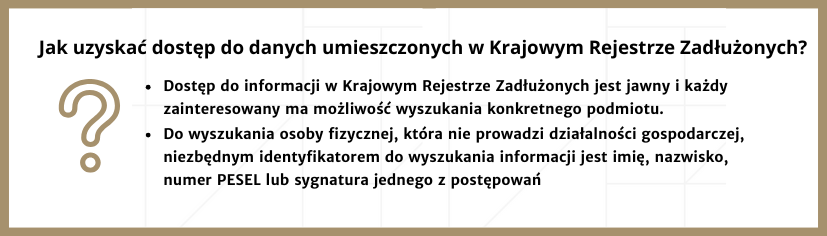
Access to information in the National Debt Register is public, and anyone interested can search for a specific entity. To search for an individual who does not run a business, the necessary identifiers are their first name, last name, PESEL number, or the reference number of a proceeding – alimony, restructuring, or bankruptcy.
Functioning of the National Register of Indebted Persons
The National Debt Register operates through four information portals. These include:
- Public Portal – anyone interested can access it without having to log in to the register.
- Registered User Portal – available to registry users after logging in to the system. They then gain access to submit documents and receive correspondence regarding ongoing proceedings.
- Register for Public Administration Bodies, enabling obligated bodies to include in the National Register of Debtors information on persons and entities against whom they have been in the past judicial execution conducted lor administrative and was discontinued due to its ineffectiveness, as well as information about persons against whom enforcement of maintenance payments or state budget receivables is underway.
- Industry User Portal, where supervisors, managers and trustees carry out their activities as part of bankruptcy and restructuring proceedings.
In light of the above, it should be concluded that the National Debt Register fulfills four main objectives. First, it serves as a registry and adjudication portal, but also facilitates communication and serves an informational function in connection with the delivery of documents.
Is it possible to delete data from the National Debt Register?
From a practical point of view, it is not possible to delete data that has been entered into the National Debt Register. However, it should be remembered that the Act provides for certain periods when entity data is deleted from the National Debt Register. In the case of information about individuals subject to restructuring proceedings, or information about partners of commercial partnerships contained in Articles 5 and 6 of the Act on the National Debt Register, they cease to be automatically disclosed after 10 years from the date of final termination or discontinuation of the proceedings.
In the event of a final approval of the arrangement in the proceedings, data identifying a given entity cease to be disclosed after 3 years from the date on which the decision on its implementation becomes final or 10 years from the date on which the decision on its annulment becomes final or the arrangement expires by operation of law.
If, during the proceedings, a creditor repayment plan was legally established or a situation arose in which the liabilities were legally written off without establishing it, the identification data cease to be disclosed automatically after 3 years from the date on which the decision on confirming the implementation of the creditor repayment plan in question became final or after 10 years from the date on which the decision on annulling the creditor repayment plan became final.
If a situation has occurred in which the bankrupt's liabilities have been validly written off in the proceedings, the data shall cease to be automatically disclosed after 3 years from the expiry of the five-year period from the entry into force of the decision on conditional writing off of the bankrupt's liabilities, in the case of failure to establish a creditor repayment plan, or 10 years from the date when the decision to set aside the decision conditionally remitting the bankrupt’s liabilities becomes final without establishing a creditor repayment plan.
Please note that under bankruptcy law, the court may deprive you of the right to conduct business activity on your own account or in a civil partnership for a period of one to ten years, and acting as succession manager, a member of the supervisory board, a member of the audit committee, a representative or attorney of a natural person conducting business activity in the scope of this activity, a commercial company, a state-owned enterprise, a cooperative, a foundation, or an association. In such a case, the data of the person against whom the prohibition has been imposed ceases to be disclosed after three years from the day following the date on which the prohibition period expired.
After seven years from publication, the data of individuals against whom enforcement proceedings have been discontinued ceases to be disclosed. After the same period, information about individuals against whom enforcement of maintenance payments is pending also ceases to be disclosed.

In accordance with the provisions of the Act on the National Debt Register, it is possible to correct incorrect data entered in the National Debt Register. In such a case, the bailiff, and in specific cases also the Head of the National Revenue Administration, the relevant head of the tax office, the relevant branch director ZUS, body, who paid the benefits awarded in the event of ineffective enforcement of alimony, or the court, as a result of a request submitted by an authorized entity, shall immediately remove or change the data incorrectly entered in the National Registry Register.
Summary
The National Debt Register (KRZ) is a public information system. Its primary goal is to improve the transparency of information regarding individuals and legal entities involved in bankruptcy or restructuring proceedings in Poland. Thanks to the KRZ system, creditors, businesses, and other stakeholders have access to debt-related information, which increases the security of the credit market and improves the efficiency of debt recovery processes.
The register discloses data on both individuals and legal entities involved in bankruptcy, restructuring, or enforcement proceedings, as well as entities that have completed these proceedings. Access to this information is public and free of charge, and entities can be searched using identifiers such as first name, last name, company name, PESEL number, NIP number, or case reference number.
KRZ operates on four information portals: public, for registered users, for public administration bodies and for industry users (e.g. trustees, administrators). Registration not only facilitates communication during bankruptcy proceedings, but also serves an informative and adjudicative function.
Data entered into the register is permanent. After a specified period of time, 3 or 10 years, it ceases to be automatically disclosed, giving debtors the opportunity to "clear" their data from the public register.
In summary, the KRZ is an important tool supporting the transparency of bankruptcy and restructuring processes, enabling quick access to information on the debt of entities in Poland, which helps both creditors and debtors in their efforts to solve financial problems.

Directions of KRZ development:
In the future, the KRZ should be expanded to include automatic notification functions (e.g., alerts for entrepreneurs), a simplified search interface, integration with international databases (e.g., ECRIS), and increased accessibility for people with disabilities. It is worth considering implementing real-time debtor monitoring and API support for financial institutions.














 English
  Polish
  Ukrainian